Available Tendencies
This document describes the different types of tendencies available in the Waveform Editor and the parameters you can set for each in the YAML configuration.
Each tendency defines the behavior of the signal over a specific time interval. You can chain multiple tendencies together to create complex waveforms.
If type is omitted it is inferred from the entry's keys: ref → import, to → linear, time → piecewise, value → constant; anything else defaults to linear (so a from-only, rate-only, or bare segment is still a linear ramp). Tendencies with no distinguishing key -- the periodic shapes, smooth, and a value-less constant -- must name their type explicitly.
Common Time Parameters
Most tendencies accept the following parameters to define their time interval. You can provide the following three parameters. If only two are provided, the third is calculated automatically (start + duration = end). If all three are provided, they must be consistent.
start: The absolute time at which the tendency begins. If omitted, it defaults to theendtime of the previous tendency, or 0 if it's the first tendency.duration: The length of time the tendency lasts. If omitted, it defaults to 1.0 second (unlessstartandendare given). Must be positive.end: The absolute time at which the tendency ends. If omitted, it's calculated fromstart + duration.
Note
The Piecewise Linear Tendency is an exception and derives its time interval solely from its time parameter list. It does not accept start, duration, or end.
Constant Tendency
Represents a constant value over the specified time interval.
Parameters
value: The constant value the signal holds during this tendency. If omitted, it defaults to the last value of the previous tendency, or 0 if it's the first tendency.start,duration,end: See Common Time Parameters.
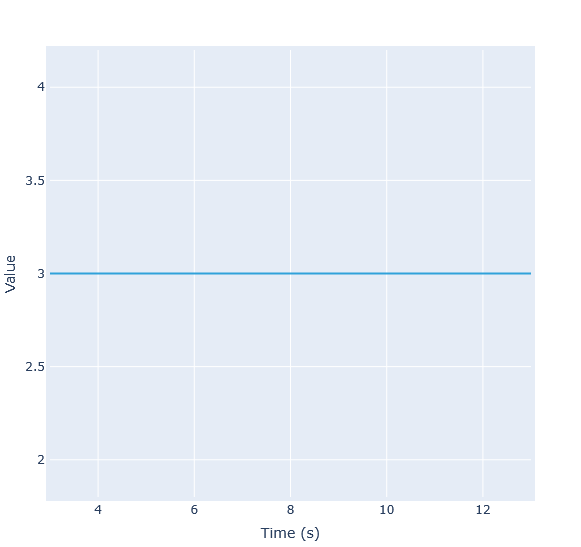
- {type: constant, value: 3, start: 3, duration: 10}
If the value is not specified, it will be set to the last value of the previous tendency. For example:
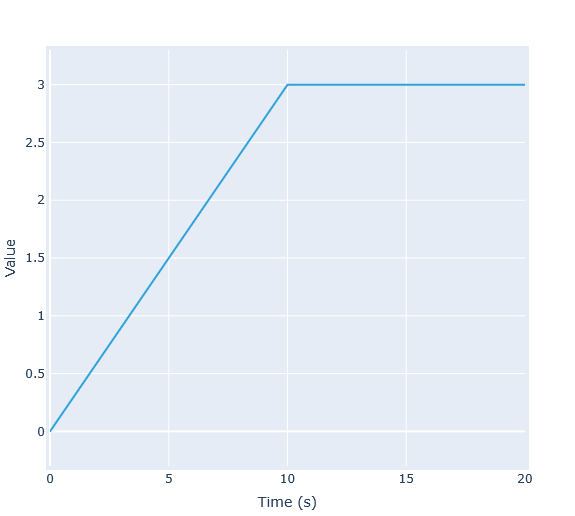
- {type: linear, to: 3, duration: 10}
- {type: constant, duration: 10}
Linear Tendency
Represents a linear change in value (increase or decrease) over the specified time interval. The line is defined by its start value, end value, and rate of change, related by to = from + rate * duration.
Parameters
from: The value at the start of the tendency. If omitted, it defaults to the last value of the previous tendency (or 0 if first tendency), unlesstoandrateare provided.to: The value at the end of the tendency. If omitted, it defaults to the first value of the next tendency if that value is explicitly set by the user, otherwise defaults to the calculatedfromvalue (implying a rate of 0), unlessfromandrateare provided.rate: The rate of change (slope) of the signal during this tendency. If omitted, it's calculated fromfromandto.start,duration,end: See Common Time Parameters.
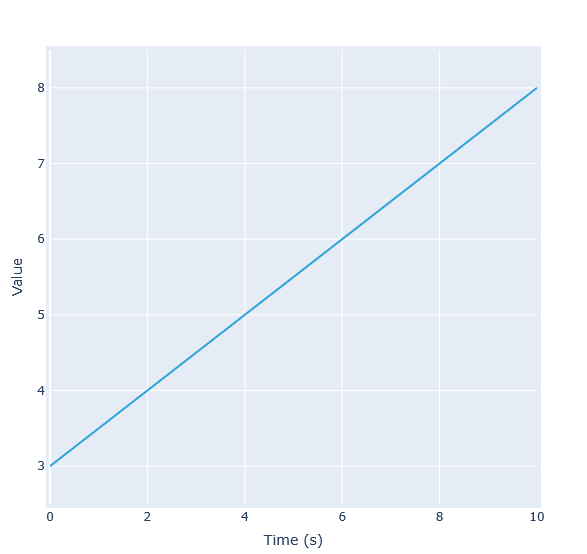
- {type: linear, from: 3, to: 8, duration: 10}
If the from or to values are not specified, they will be taken from the adjacent tendencies. For example:
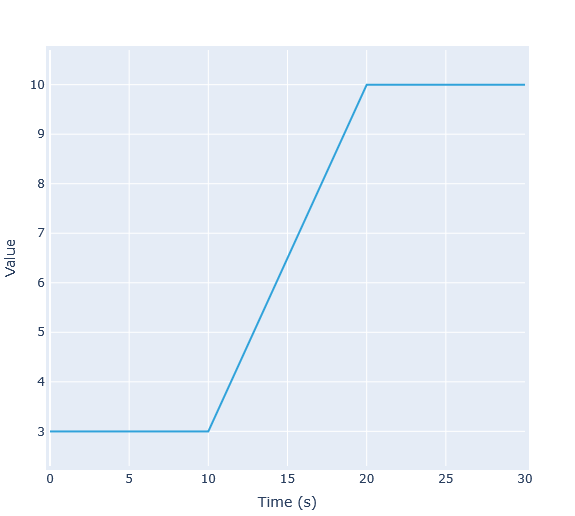
- {type: constant, value: 3, duration: 10}
- {type: linear, duration: 10}
- {type: constant, value: 10, duration: 10}
Warning
Providing inconsistent from, to, and rate values (where from + rate * duration != to) will result in an error. For example:
- {type: linear, from: 3, to: 5, rate: 2, duration: 10}
Smooth Tendency
Represents a smooth transition between the end of the previous tendency and the start of the next tendency using a cubic spline. This ensures that the value and the derivative (rate of change) are continuous at the boundaries between smooth tendencies and their neighbours.
Parameters
from: The value at the start of the tendency. If omitted, it defaults to the last value of the previous tendency (or 0 if first tendency).to: The value at the end of the tendency. If omitted, it defaults to the first value of the next tendency if that value is explicitly set by the user, otherwise defaults to the calculatedfromvalue.start,duration,end: See Common Time Parameters.
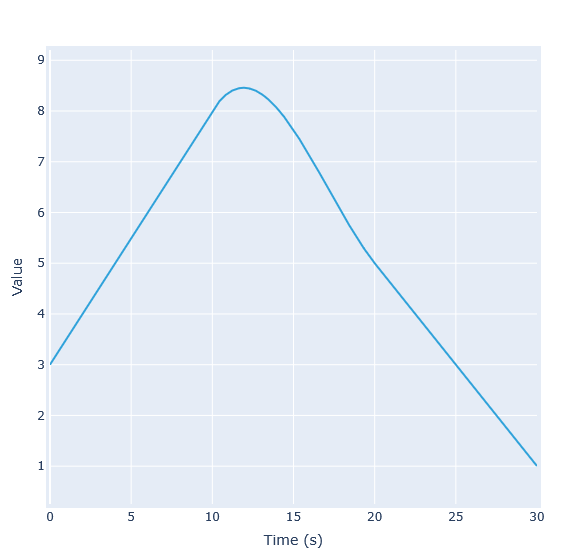
- {type: linear, from: 3, to: 8, duration: 10}
- {type: smooth, duration: 10}
- {type: linear, from: 5, to: 1, duration: 10}
Note
The start and end derivatives are automatically set to match those of adjacent tendencies.
Repeat Tendency
Repeats a defined sequence of inner tendencies (a sub-waveform) multiple times. Optionally the period/frequency can be provided to stretch or compress the time-axis of the waveform to match the specific frequency.
Parameters
waveform: A list defining the sequence of tendencies to be repeated. This follows the same format as the main waveform definition. The start time of the first tendency must be 0.frequency: The number of repetitions of the inner waveform per unit time. Must be positive.period: The duration assigned to one full repetition of the inner waveform. Must be positive.start,duration,end: See Common Time Parameters. These define the total interval over which the repetition occurs.

- type: repeat
  duration: 30
  waveform:
  - {type: constant, value: 1, duration: 3}
  - {type: linear, from: 1, to: 2, duration: 3}
  - {type: smooth, duration: 5}
If you want to keep the same repeated waveform as above, but would like to set the period of the repetition to be exactly 10 seconds, you can use the period or frequency parameter, for example:

- type: repeat
  duration: 30
  period: 10
  waveform:
  - {type: constant, value: 1, duration: 3}
  - {type: linear, from: 1, to: 2, duration: 3}
  - {type: smooth, duration: 5}
Piecewise Linear Tendency
Defines a sequence of points connected by straight lines.
Parameters
time: A list of time points. Must be strictly monotonically increasing and must have at least 1 point.value: A list of corresponding values at each time point in thetimelist. Must have the same length astime.

- {type: piecewise, time: [0,1,2,3,6,7], value: [5,3,4,1,8,4]}
Warning
This tendency does not accept the common start, duration, or end parameters. These are derived directly from the required time list.
Import
Takes its values from an external entry in globals.imports instead of an analytic shape, resampled onto the export time base. By default it reads the waveform's own DD path.
Type: import (inferred when ref is present)
Parameters
ref: Entry inglobals.importsto read from.path: DD path to read. Defaults to the waveform's own path.time_offset: Offset added to the export time when sampling. Defaults to0.interp: Resampling mode:closest(default),linearorprevious.
core_sources/source(1)/profiles_1d/electrons/energy:
  - {ref: scenario, interp: linear}
Wildcards expand against the source: a trailing * imports a whole subtree (<ids>/* copies a whole IDS), and a (*) index wildcard iterates every element of an array of structure -- several may be combined, e.g. every ion of every source. An overlay may list several sources, applied in order:
core_sources/source(*)/profiles_1d/ion(*)/z_ion:
  - {ref: scenario}

ec_launchers/*:        # whole-IDS overlay; sources stack
  - {ref: machine}
  - {ref: scenario}
Precedence. Where imports or explicit waveforms write the same node, the most specific wins regardless of order: <ids>/* < subtree .../* < explicit leaf. Equal specificity falls back to listing order (last wins).
Non-0D imports (a profile, a wildcard subtree) own the whole waveform. Only 0D (scalar) imports combine with analytic segments, each filling its [start, end] window:
equilibrium/time_slice/global_quantities/ip:
  - {type: constant, value: -1.0, duration: 1}   # analytic on [0, 1] s
  - {ref: scenario, duration: 1}                 # imported on [1, 2] s
Periodic Tendencies
These tendencies represent various oscillating waveforms (Sine, Sawtooth, Triangle, Square). They share common parameters for defining the oscillation's characteristics.
Common Periodic Parameters
type: The type of the oscillating waveform. Examples of each type are shown below.frequency: The number of cycles per unit time. Defaults to 1.0 ifperiodis also omitted.period: The duration of one cycle.base: The baseline or center value of the oscillation (average value).amplitude: The amplitude of the oscillation.min: The minimum value reached by the oscillation.max: The maximum value reached by the oscillation.phase: The phase shift in radians. A positive phase shifts the waveform to the left. Defaults to 0. The value is wrapped to the interval [0, 2π).start,duration,end: See Common Time Parameters.
Warning
Providing both frequency and period is invalid if frequency != 1 / period. Providing more than two of base, amplitude, min, max is also not valid.
Sine Wave
A smooth oscillation following a sine function.
Type: sine
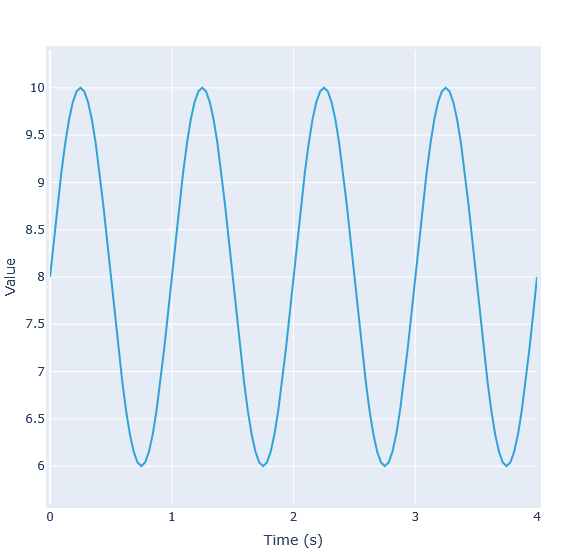
- {type: sine, base: 8, amplitude: 2, frequency: 1, duration: 4}
Sawtooth Wave
Linearly increases from minimum to maximum, then instantly drops back to minimum.
Type: sawtooth
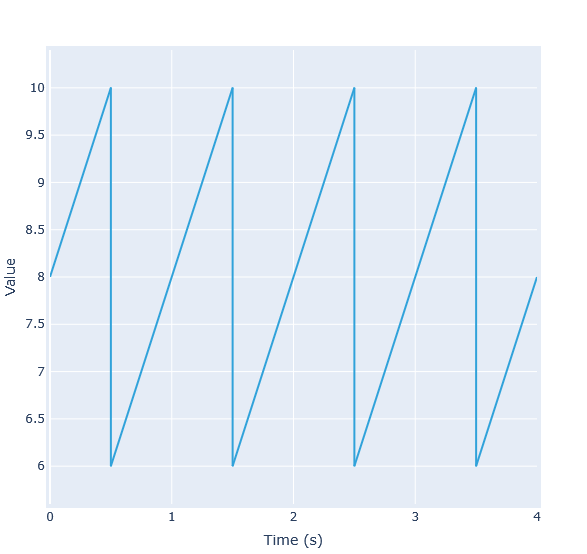
- {type: sawtooth, base: 8, amplitude: 2, frequency: 1, duration: 4}
Triangle Wave
Linearly increases from minimum to maximum, then linearly decreases back to minimum.
Type: triangle
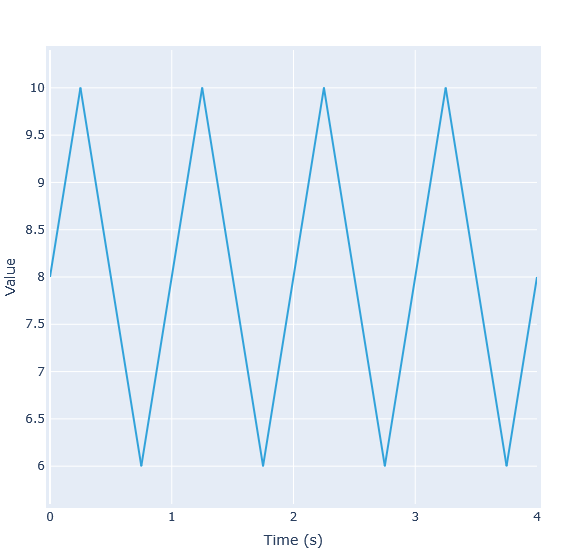
- {type: triangle, base: 8, amplitude: 2, frequency: 1, duration: 4}
Square Wave
Instantly switches between minimum and maximum values.
Type: square
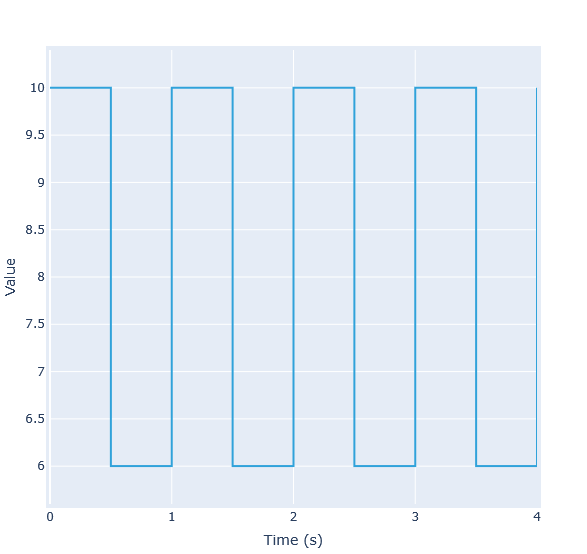
- {type: square, base: 8, amplitude: 2, frequency: 1, duration: 4}